I recently finished reading Christine Kenneally’s The Invisible History of the Human Race: How DNA and History Shape Our Identities and Our Future.
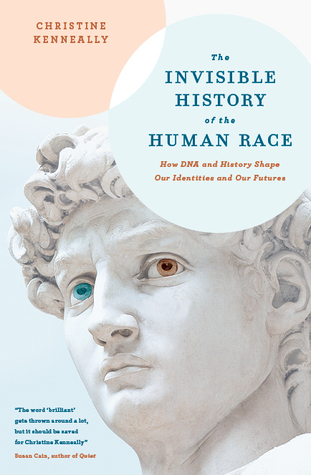
Given as a birthday gift by a friend last year I had put off reading this book until after I finished my PhD. The gift-giver has previously won on the book selection front when I was given Matt Ridley’s Genome a few years ago, so I was confident that this was going to be a winner.
Plus, Susan Cain, author of Quiet, another fantastic read, is quoted on the front cover with “The word ‘brilliant’ gets thrown around a lot, but it should be saved for Christine Kenneally”
This book was written for the general public, however even as a scientist with human genetics training I found it to be a fascinating read. It covered so many topics and issues faced in human genetics research but was particularly centred around the idea of how our genetic make up, the convergence of all our ancestral pairings, contributes to our idea of self, with a large focus on familial genetics (which is great because that’s my field)
Each chapter begins with a personal story or character of some description that is used as the narrative for the chapter. The author uses the personal stories of the people she’s interviewed to weave together high level genetic concepts with their direct application and implication in everyday life.
A recurring topic is the concept of genetic contribution to ancestry. Kenneally makes the clear distinction that ancestry and race are different. My understanding is that ancestry is the genetic history that lead to Individual X’s genome. This may have been combinations of ancestors from different countries and different gene pools across the world. Race instead is a social concept and has several more sinister implications as it has been used in the past to categorise people into levels, with some races being wrongly perceived to be superior to others. Direct-to-consumer genetic testing from companies such as 23andMe, amongst others, have made it very accessible for any individual to determine their genetic history and their ancestor’s origins.
We’re now at point with genetics that not only can we tell someone that they have Chinese, English or Irish ancestry, we can also given the right population study show the direct area of a country that an individual’s ancestors originated from, as has been shown with the fine-scale geomapping using the People of the British Islands study run by Peter Donnelly at the Wellcome Trust Centre for Human Genetics.


Sometimes as geneticists we become myopic on our research area and frustrated by various challenges. Books like this make us consider genetics as a whole and the vast and wide-spreading impact of the research field we work in.
As a geneticist, one thing i’m aware of in reading this book is that many of the analyses Kenneally explains so well have been conducted using SNP arrays, analyses of common genetic variation in populations. While findings from these types of data are extremely valuable, we’re now in the era of whole genome sequencing, where we can examine not only common variation, but rare genetic variation, variation that’s present in less than 5% and less than 1% of the general population (or even private to a specific family). What new information resolution level this type of variation would add to the stories described in this book would be extremely interesting to know.
 Nick's Niche.